
Digital Twin-Enabled Predictive Intelligence Framework for Supply Chain 5.0: Hybrid Deep Reinforcement Learning Architecture for Real-Time Adaptive and Self-Optimizing Decision Management
DOI:
https://doi.org/10.62019/z34j8b27Abstract
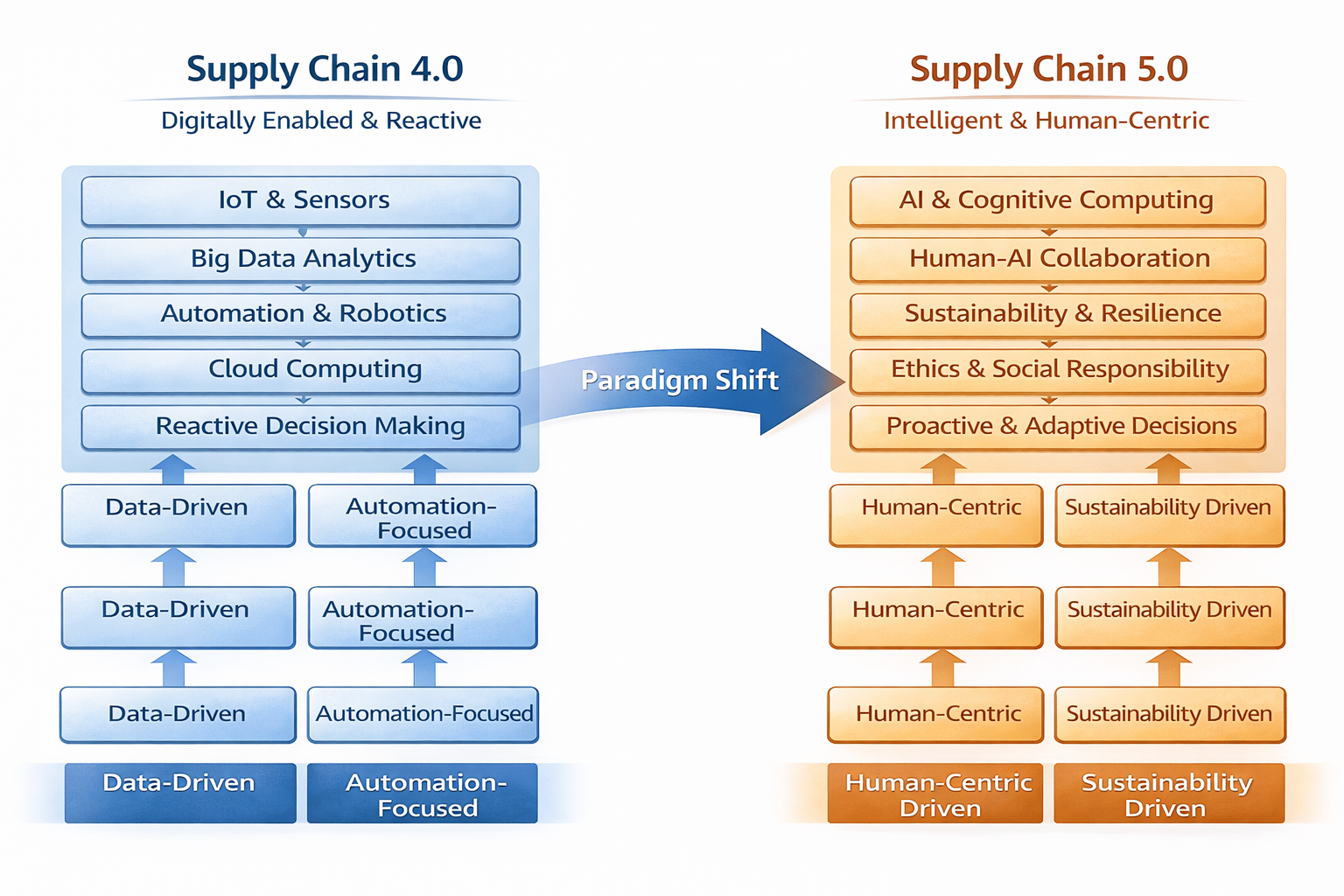
The rapid evolution of global supply networks, characterized by increasing uncertainty, demand volatility, and systemic disruptions, has exposed the limitations of conventional optimization-based and rule-driven supply chain management systems. In response to these challenges, the emerging paradigm of Supply Chain 5.0 emphasizes human-centricity, resilience, sustainability, and intelligent autonomy through advanced cyber-physical integration. This study proposes a Digital Twin–enabled predictive intelligence framework for Supply Chain 5.0 that integrates real-time data synchronization, hybrid deep reinforcement learning, and adaptive decision management to achieve self-optimizing and resilient operational control. The proposed framework establishes a high-fidelity digital twin that continuously mirrors the physical supply chain by assimilating heterogeneous data streams from demand signals, inventory states, logistics operations, and disruption indicators. This cyber-physical representation serves as an interactive simulation environment for intelligent policy learning and scenario evaluation. At the core of the framework, a hybrid deep reinforcement learning architecture is developed by combining model-free policy learning with model-based optimization elements, enabling both strategic foresight and rapid tactical adaptation under dynamic conditions. The learning agent is designed to optimize multi-objective performance criteria, including operational cost efficiency, service-level reliability, disruption resilience, and sustainability-oriented metrics, while maintaining real-time responsiveness. Unlike static optimization or reactive control approaches, the proposed predictive intelligence mechanism enables proactive anticipation of demand fluctuations, transportation delays, and supply disruptions through continuous interaction with the digital twin. Furthermore, a human-in-the-loop governance layer is incorporated to ensure explainability, supervisory control, and ethical alignment of autonomous decisions, reinforcing the human-centric vision of Supply Chain 5.0. The effectiveness of the proposed framework is evaluated through a multi-echelon supply chain simulation under diverse uncertainty scenarios, including stochastic demand patterns and disruption events. Comparative analysis against traditional optimization and standalone deep reinforcement learning baselines demonstrates substantial improvements in decision adaptability, recovery speed, and overall system robustness. The results highlight the framework’s ability to dynamically reconfigure sourcing, inventory, and distribution strategies in real time while maintaining stability and performance. Overall, this study contributes a scalable and intelligent decision-making architecture that advances digital twin–driven autonomy in next-generation supply chains, offering significant theoretical and practical implications for resilient, adaptive, and human-centric supply chain management.
Downloads
Published
Issue
Section
License
Copyright (c) 2026 Omar J. Alkhatib , Muhammad Irshad Hussain, Raza Ali Nawaz, Muhammad Umar Amin, Ajab Khan

This work is licensed under a Creative Commons Attribution-NonCommercial-NoDerivatives 4.0 International License.
How to Cite


