
Reducing the Impact of Path Loss in Internet of Health Things Based on Residual Energy Calculation
DOI:
https://doi.org/10.62019/29zny287Keywords:
IoT, Sensors, Routing Protocol, Efficiency.Abstract
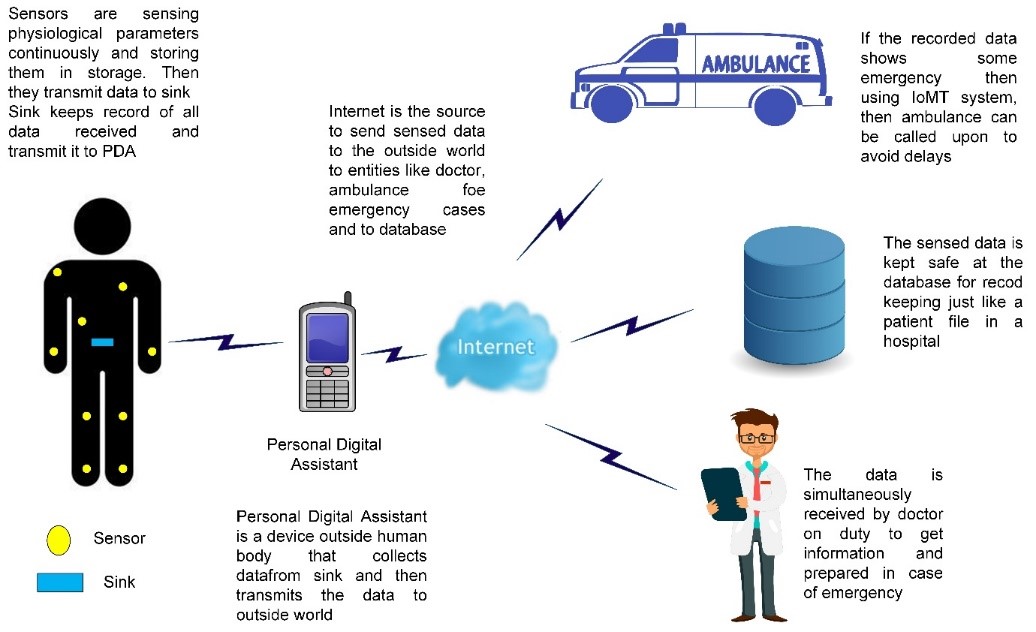
Internet of Health Things is a sub field of Internet of Things that deals with the human physiological monitoring. It is a specialized field comprising on small state of the art devices that are used to record human vital signs and changes that occur. The recorded data transmission is wireless in nature so there are factors like path loss that come along to make wireless transmission ineffective. Energy efficiency and reliable communication are most critical challenges in Internet of Health Things. Path loss is a critical parameter which directly impacts on reliability as well as on energy consumption of wireless communication systems, influencing quality of communication between sensor nodes and sink. This study analyzes the evolution of path loss over network rounds to evaluate the stability and energy performance of an adaptive routing scheme. This research proposed in this paper investigates variations in path loss across occurred in multiple transmission rounds in an Internet of Health Things environment also focusing on achieving the efficiency in terms of energy in a routing protocol.
Downloads
Published
Issue
Section
License

This work is licensed under a Creative Commons Attribution-NonCommercial-NoDerivatives 4.0 International License.
How to Cite


